Thursday, 17 February 2011

LECTURE 4: Aestheticism and the Palace of Art: Burne-Jones and the scandal of the Grosvenor Gallery

We left Aesthetic painting with Burne-Jone's picture The Lament of 1867. It conveys the sense of strong emotion, but has no narrative and no moral content. It cannot be placed in any exact historical period, but it lyrical use of colour is directly related to the musical element in the painting.


Burne-Jones, together with artists like Simeon Solomon and Rossetti were making their names in this new genre of painting when Jones ran into trouble with his Phyllis and Demaphoön (1870) at the Society of Painters in Watercolour. The members of the Society were offended by Demaphoön's nakedness and Phyllis's female assertiveness. Rossetti's Astarte Syriaca (1876) was in rather the same vein, a strong study of a powerfully sexualised Venus based on the figure of Jane Morris. He attached a sonnet which underlined the mystical element of the picture, but did not conceal its libidinous qualities.


At the same time Walter Pater was extending his book Studies in the History of the Renaissance (first published in 1873) with an essay on the Venetian artist Giorgione. Giorgione appealed to the Aesthetes because many of his paintings were meditative studies with no obvious narrative. We saw how, some years ago, Dante Gabriel Rossetti had been attracted to Giorgione's work in the Louvre. Now in a strong statement about the primacy of form over matter, Pater asserted that all art aspired to the subjectless condition of music.


To many people, Pater's ideas and those of some of his fellow Aesthetes, were extreme and possibly ridiculous, and one writer in particular, William Mallock, wrote a parody of the emergent ideas on art entitled The New Republic in which Pater featured as Mr Rose.


But the momentum around Aestheticism was gathering. Swinburne's poetry, Rossetti's and Burne-Jone's painting, and Pater's criticism were all becoming associated with values that seemed troubling to the Establishment. Prominent among those who were disturbed were the members of the Royal Academy who could find no place for the new painting on their walls, and to which, in any case, the Aesthetes did not want to submit their work. The reason was that the conditions for hanging works of art at the RA were very poor. The spaces were filled to capacity and many pictures were hung so high that it was impossible to see them. Even in the nineteenth century the situation had not improved very much. Frith's representation of the private view at the Academy in 1881 makes this clear.


Around 1876, Sir Coutts and Lady Lindsay stepped in. He was a rich banker with a taste for modern art and he saw the dilema in which the new painters found themselves. They needed a purpose-built gallery with quite different conditions for the display of works of art.


Coutts Lindsay seeing himself as a latter day Medici, spent a huge amount of money building a new gallery in Bond Street that would be like no other. Opening in 1877, inside it exhibited a kind of Renaissance splendour where works of art had lots of space and room to breathe. Coutts Lindsay encouraged a whole range of new artists including women to exhibit in this new 'Temple of Art'.


Whistler showed 8 paintings, among them the famous Nocturne in Black and Gold: the Falling Rocket that had all the hall-marks of the Aesthetic style. 


Ruskin greeted it with disdain, publicly claiming:


The two men went to court over Ruskin's abusive remarks, and after a comic and protracted case (the details of which Whistler later painted), Whistler was judged to have won, though he was awarded on a farthing's damages. Whistler's reputation was damaged by Ruskin's attack, and it took some time to recover, meanwhile the 'lion' of the first few exhibitions at the Grosvenor Gallery was Burne-Jones who came back into exhibiting and back into the public eye.


The Mirror of Venus (1877) caused a considerable stir with its strange androgynous young female figures placed in a lunar landscape each one contemplating her own reflexion. Some saw this as an emblem of Aesthetic self obsession and narcissism. Vanity Fair was characteristic:


One of the most interesting reviews came from Henry James, though he was highly ambivalent in his attitudes. He responds to the originality of Burne-Jones' work, but he finds it mannered and unhealthy.


To others, Burne-Jones's paintings were the expression not just of ill health but of sexual perversion.


The Chant d'Amour (1878), with its suspicious French title, was thought to represent, metaphorically, post-coital langour. and even more offensive was Burne-Jones's picture Laus Veneris, derived from a poem by Swinburne of the same name, and closely connected to Wagner's opera Tannhauser.


The critics saw in Venus a sexually depraved figure, abandoned, subversive and disgusting.


Other response to what were perceived as the excesses of Aestheticism came in the form of jokes, cartoons, and parodies. These abounded, and often featured the appearance of world-weariness, langour, androgyny, and angularity of the figures mainly taken from pictures by Burne-Jones.


Wednesday, 16 February 2011

LECTURE 5: The Aesthetic interior


Godwin whose involvement with the movement was extensive had a long affair with Ellen Terry from 1868-1874 designed some of the finest furniture in a Japanese mode.


He also designed this building, The White House, for the painter Whistler.


While Whistler himself, as we have seen, was hugely impressed by Japanese woodcuts that he had first seen on his trips to Paris.


Whister was also extremely interested in designing dress and this Japanese Aesthetic dress was created for Mrs Frances Lelyland the wife of a nothern millionaire Frederick Leyland. The picture above was hung in his famous or infamous 'Peacock Room' that he created for Leyland in 1877.


This came as a great shock to Leyland who had not approved or supervised the work. They quarrelled over the cost. He told Leyland that this would be remembered when Leyland was fogotten. Ultimately the interior was bought by the industrialist Charles Freer and after his death in 1919 went to the Freer gallery in the Smithsonian museum of art.


Equally under the spell of Japan was the outstanding designer Christopher Dresser. He started life as a botanist, but then toured Japan in the early 1876-7 and published his influential Art and Manufacture of Japan in 1882.


Running parallel to those central to the Aesthetic movement were members of Arts and Crafts groups and societies. One of the earliest was formed by A. H. MacMurdo who was an innovative and original designer. The cover for a book on churches is one of his masterpieces.


In 1882 he founded the Century Guild with its own journal The Century Guild Hobbyhorse.


W. R. Lethaby and others founded another group, The Art Worker's Guild in 1884 that sought to find a sympathetic unity among practitioners of different branches of art. 


The Morris inspired guilds were extremely influence in Europe where the set the ball rolling for different varieties of Aestheticism in Holland, Germany, France, and Italy.


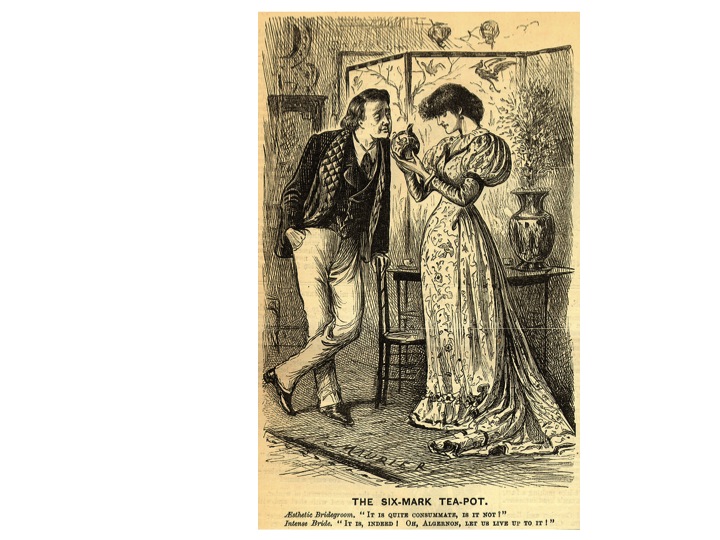
British Aestheticism became a way of life for some, and was much parodied in the press and elsewhere.


The most famous of these was Gilbert and Sullivan's comic opera Patience in which Aestheticism was represented as comic, false and affected. Nevertheless its notoriety gave much impetus to the movement, and it was possible to buy clothes modelled on those worn in the opera.


Japanese chairs, fans, peacock feathers, blue china and loose clothing all feature in the life of the true Aesthete.


But as Aestheticism became more and more socially acceptable, so the possibilities of Aesthetic dress.


Rational dress was an extension of Aesthetic dress into a utilitarian mode based on a philosophy of a healthy life-style. It had its own journal with carefully argued essays on the benefits of rational dress and the evils of corsets and tight lacing. It had its origins in 1881, so ran a parallel course to that of Aesthetic dress.


The aims and objects of its founders were those for which many women had long been arguing, and soon the whole movement became caught up in issues about female education and the female franchise.


Just as the Bloomer campaign in the mid 1850s had its opponents, so did rational dress. Some saw it as turning women into men.


Or worse, made out of women bicycling 'new' women who violated the fundamental priorities of Victorian society. 


Beardsley like many artists of this period were much influenced by Japan.


and this and other mannerisms of his style were widely parodied. His illustrations for Juvenal, for example


were treated by Linley Sambourne thus where the implications are clear


Beardsley, however, took Aestheticism into new realms. He was not the only practitioner of Decadent art, but he was one of the most outstanding.


In his illustrations for Salome, he scandalized many readers.


and this together with the erotic relationship between Salome and John the Baptist outraged the British public.


When in 1905 Richard Strauss set Wilde's play to music in the opera, Salome, the public across Europe and America were startled and disgusted once again. So, with the Strauss, a movement that could be said to have started with the Pre-Raphaelites reached its apogee. It had no left the province on Aestheticism and was beginning on a new journey into something quite different.